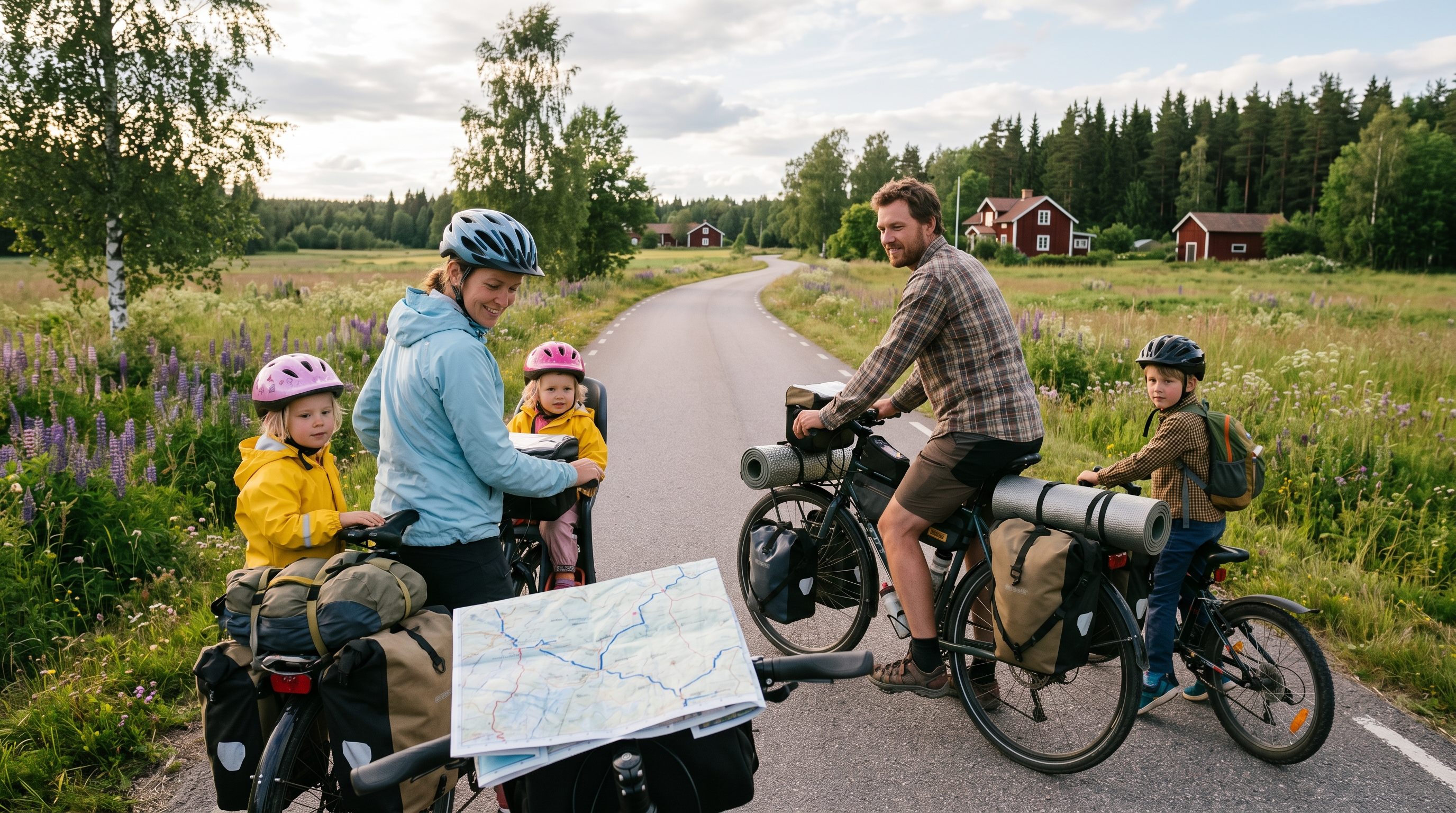
Two nights in Söderköping, Sweden, do not need to mean a long ride every day. For a first cycling holiday with children, I would choose a base to return to and begin with a short trial ride before booking the next night several kilometres away.
A useful daily stage leaves energy for the return journey and the evening. Riding experience, traffic and pauses offer a better starting point than a universal distance limit.
Choose the first stage with a trial ride
Before the holiday, try the bicycles, trailer and roughly the luggage you intend to use. Pick a short outing you can turn back from early. Record riding time separately from total outing time, and notice how much energy your child has left at home.
Göta kanal's advice for cycling holidays with children suggests 5–10 kilometres as an often reasonable daily distance. Treat that as a cautious example to compare with your trial, not a promise about what a child of a particular age should manage. A child pedalling and a child riding in a trailer need different kinds of breaks.
For a calculation example, if your trial averaged 10 km/h while moving, an 8-kilometre outing takes 48 minutes of riding. Add 45 minutes for food and play and the outing already lasts 1 hour 33 minutes, before extra stops. Gravel or a headwind can make the same distance take longer.
Start short. Extend later. Do not book the next overnight stop around adult training speed before you know how your family's travel day works.
Choose a base or move accommodation each night
For a first cycle-touring holiday, a base lets you leave heavy luggage behind and adjust the outing as you go. I would choose it for a first weekend, especially with a child new to longer rides. An out-and-back outing still needs a turning point: a child tired at the picnic stop must also get home.
Moving each night suits a family that has already tried riding with luggage and knows its stages are manageable. Review the whole section for traffic, hills, surface and a way to stop early. Do not assume a bus or train will carry the family's bicycles and trailer without checking the operator's conditions.
Choose road character before short distance
A busy country road creates constant concentration even with a broad shoulder. Fast vehicles, noise and air movement consume attention that could have gone to riding together.
Separated cycle paths and traffic-free routes let children relax, talk and stop safely. Surface matters too: smooth asphalt preserves energy while loose gravel and rough paving work smaller wheels and heavy trailers much harder.
Hills are visible on a profile; a long headwind is easier to underestimate. Keep shortcuts and alternative stops so the day's target can change with weather without becoming a failure.
Make the pause part of the holiday
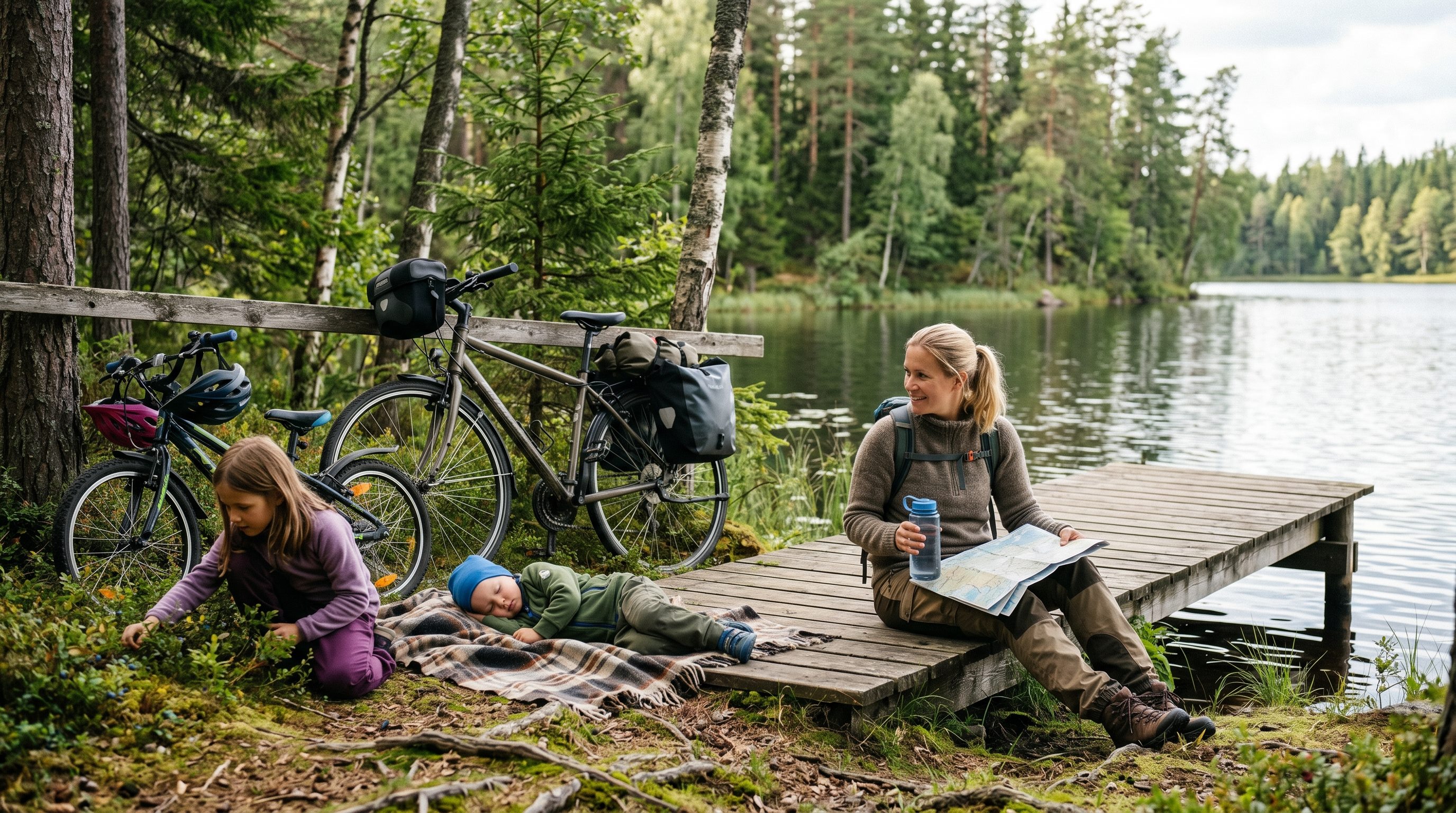
For a child, the stream for throwing stones, roadside ice cream and horses beside the path may matter more than the named destination. Pauses are not interruptions. They are often the trip.
Keep snacks accessible and stop before hunger becomes an energy crash. Waiting for the next village can be a poor gamble when it is an hour away into the wind.
Movement of another kind resets the day after a trailer or sustained pedalling. A playground, beach or open patch of grass gives children a proper break and adults a calmer second half.
Simplify the overnight routine
Practical accommodation beats a perfect photograph. Look for secure, dry bicycle storage, somewhere to dry wet clothing, easy access with panniers and a simple way to organise dinner.
Campsites, cabins, hostels and tents can all work when the same basic needs are met. After eating, check tyres, find rainwear and set out the first morning items. Ten quiet minutes in the evening can transform departure.
Pack for access during the day
Rainwear, spare children's clothes, water, food, sunscreen and basic first aid should be reachable without emptying every pannier. Waterproof bags remove one source of uncertainty.
Distribute weight across the adults and account for whoever pulls a trailer. Remove what the family will not use; every unnecessary item is carried over every hill and handled at every overnight stop.
Save your family's stages
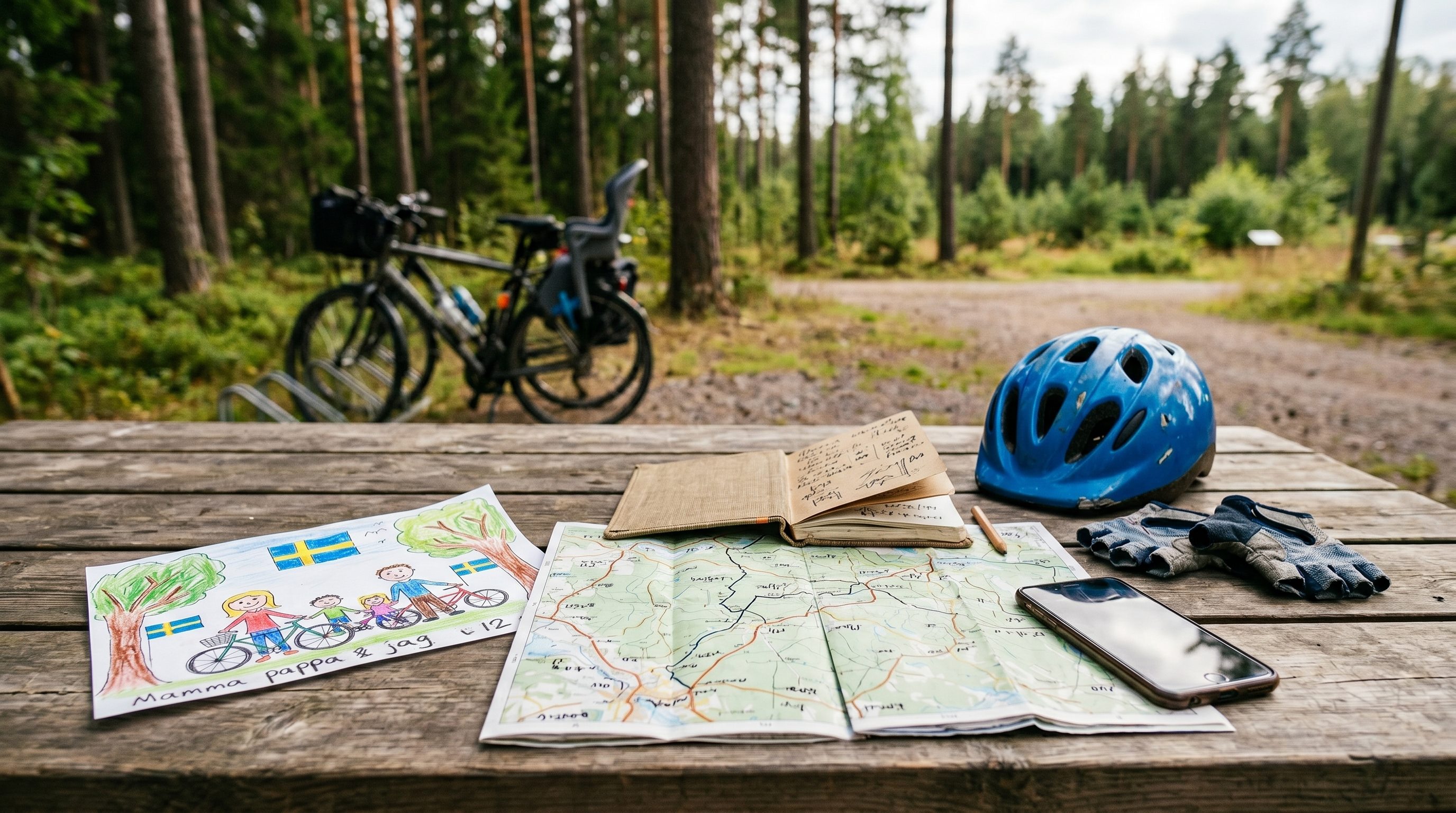
Imagine two cycling days from the same accommodation in Söderköping. The shorter outing took longer because the play break became the highlight. Keeping the place, photograph and child's comment together in FARON lets you find the family's journey again on the trip map.
Add riding time and breaks to a short note. Your own travel day then gives you something more useful for the next plan than a distance alone.
Keep the difficult lessons too
Rain in a bus shelter, hunger before lunch and a tired final kilometre often teach more than the smooth days. Record what rescued the situation while the sequence is clear.
Some children need many short stops; others prefer a longer ride followed by a real rest. Short. Flexible. Once the family finds its rhythm, cycle touring becomes a close encounter with weather, roads and small places rather than a contest against the itinerary.
Start with a manageable first trip in FARON and preserve the details that will make the next route calmer.
Frequently asked questions
How long should stages be when cycle touring with children?
Start with a short trial using the family's bicycles and luggage. Göta kanal suggests 5–10 kilometres as a cautious example, not an age-based rule. Adjust for experience, traffic, surface and energy for the return.
What matters most when planning a family cycle tour?
Choose low-traffic routes and generous pauses, with a plan that can be shortened when weather or energy changes.
What makes suitable family cycle-tour accommodation?
Prioritise secure bicycle storage, space to dry clothing, easy access with luggage and simple food and morning logistics.
How can we save memories from a cycle holiday with children?
Use FARON to connect stages, pauses, photographs, overnight stays and children's comments on the family's private map.