A standard Swedish category B licence covers a motorhome with a registered gross weight of up to 3,500 kg. Heavier motorhomes normally require C1 or C, with an exception for some older B entitlements. In Sweden, passenger car class II follows posted speed limits; registration as a heavy lorry or towing a trailer changes the limits.
Match the licence to the registered gross weight
In Sweden, a standard category B licence covers a motorhome registered as a passenger car with a gross weight of no more than 3,500 kg. Above 3,500 kg, category C1 or C is normally required. C1 covers medium-sized vehicles up to 7,500 kg; C has no corresponding upper vehicle-weight limit.
Read the registration certificate rather than judging the model or length. Similar-looking motorhomes can be registered at 3,500 kg, 3,850 kg or 4,250 kg. The higher figure may provide a useful payload for water, gas, bikes and luggage, but it also changes the licence requirement.
Sweden's Transport Agency gives the current definitions on its pages for passenger car class II and C1 and C licences.
Check the pre-July 1996 category B exception
A Swedish category B licence first obtained before 1 July 1996 can retain the right to drive a passenger car above 3,500 kg. The entitlement must not have been revoked since that date; it is not always shown as an obvious code on the physical card. Verify the record with the Transport Agency and the rental company before relying on it.
Does B96 cover a 4,250 kg motorhome?
B96 does not raise the motorhome's own weight limit. Under the Swedish Transport Agency's licence rules, 4,250 kg is the combined registered weight of the car and trailer; the car itself remains limited to 3,500 kg.
If I were hiring in Gothenburg and choosing between 3,500 kg and 4,250 kg motorhomes, I would ask for the registration details before booking the heavier one. B96 is not enough. Packing less does not help. Confirm the required entitlement before choosing the vehicle and then calculating its available payload.
Future EU rules do not grant that right today
The Agency's guidance on forthcoming rules, checked on 16 November 2026, describes a future extension of category B for motorhomes up to 4,250 kg after training or a test. Sweden's choice is not yet settled. Most of the directive's rules are to apply from 26 November 2029.
The separate change from 26 November 2027 for certain alternatively fuelled cars excludes motorhomes. Book according to your current entitlement: a heavy passenger car class II still requires C1/C or a valid older B entitlement under the current vehicle rules.
Use the vehicle class to understand speed
Most Swedish motorhomes are registered as passenger car class II. They have no separate motorhome speed limit: the driver follows the posted limit while adapting to weight, road and stopping distance. The correct driving licence is still required when the vehicle exceeds 3,500 kg.
A motorhome registered as a heavy lorry is limited to 90 km/h on motorways and motor-traffic roads, and 80 km/h on other roads in Sweden, subject to lower posted limits. The registration certificate therefore matters for both weight and vehicle class.
Trailers add another set of limits
When towing, check the licence entitlement, the motorhome's permitted trailer weight and the trailer's construction. A braked trailer is normally limited to 80 km/h in Sweden. An unbraked light trailer may be limited to 80 or 40 km/h depending on the weight relationship.
Do not assume that B96 changes the motorhome's own 3,500 kg ceiling. B96 concerns a car-and-trailer combination up to 4,250 kg while the car itself remains no more than 3,500 kg. For a heavy motorhome with a heavy trailer, C1E or CE may be required.
Recheck every country on a European trip
In Norway, motor vehicles over 3,500 kg are normally limited to 80 km/h on roads with a higher posted limit. A category M1 motorhome without a trailer and with a maximum authorised mass of up to and including 7,500 kg may follow the posted limit if its tyres are rated for that limit.
Licence recognition and speed rules change at borders, and many countries distinguish at 3,500 kg. Road type, rain, environmental zones and trailer rules may change the practical limit again. Use current official national information shortly before departure instead of carrying an old Europe-wide table from one season to the next.
Payload changes the route before the first kilometre
Suppose the ready-to-travel motorhome, including everyone and everything aboard, weighs 3,200 kg and its registered ceiling is 3,500 kg. That leaves 300 kg below the ceiling, but axle limits still apply. If 3,200 kg is instead a catalogue figure, the travel-ready weight is not yet known. Weigh it as you will drive it.
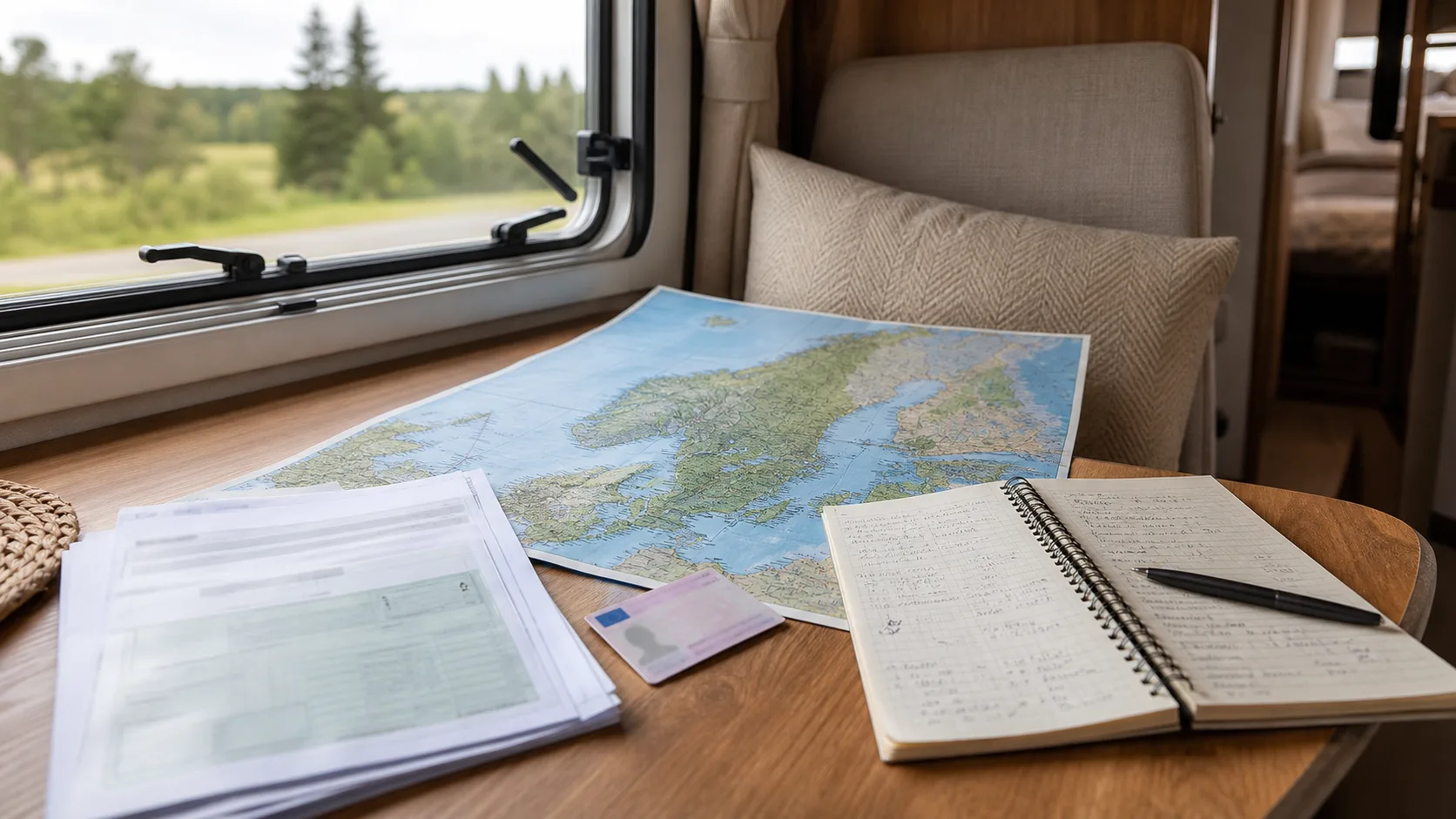
Confirm registration and licence entitlement before hiring or changing the registered weight. A larger model does not automatically provide more usable payload.
Keep the driving days you actually experienced
The regulation check belongs before departure. Afterwards, the useful details are often different: which motorway stage felt too long, where crosswinds made 90 km/h tiring and which overnight stop gave the driver a proper break.
Save those stages, nights and notes in FARON's private motorhome archive. The next plan can then use your own driving rhythm rather than a theoretical maximum.
Frequently asked questions
Is a category B licence enough for a motorhome in Sweden?
Yes, for a motorhome with a registered gross weight up to 3,500 kg. A heavier motorhome normally requires C1 or C unless a verified transitional entitlement applies.
How fast may a motorhome drive in Sweden?
A motorhome registered as passenger car class II follows posted limits. As a heavy lorry, it is limited to 90 km/h on motorways and motor-traffic roads and 80 km/h elsewhere, or a lower posted limit.
What changes when the motorhome tows a trailer?
The combination must satisfy licence, permitted-weight and trailer-speed rules. A braked trailer is normally limited to 80 km/h in Sweden.
Does an old Swedish category B licence cover heavier motorhomes?
It can if category B was first obtained before 1 July 1996 and the transitional entitlement remains valid. Confirm the official licence record before driving.